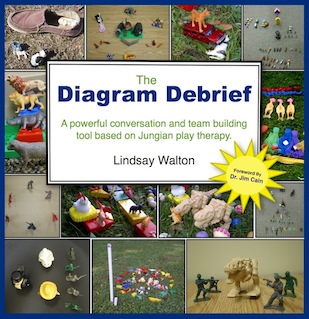
Foreword written by Dr. Jim Cain of Teamwork & Teamplay
Need new team building ideas? Fun and incredibly insightful, the Diagram Debrief is a tool that helps people to start a conversation with their teammates, and with themselves!
What Insight Is Available?
Flow and nature of strength and influence: The diagram can help your team to see where power and influence are concentrated within the group and how it is being used. For example, people with influence are often shown as being at the top of the diagram, raised above the rest of the diagram, or they are represented by larger items than those found in the rest of the diagram.
Connection and disconnection: Teams can get a better sense of how connected they are, and where connectivity may be distant, strained, or broken. For example, teams often communicate connection by creating lines that group items together or keep them apart. They also communicate connection by placing objects closer together or farther apart.
Characteristics of individual team members: The pieces chosen to represent each member of the team can provide a lot of insight in to how they are viewed by the broader group, including which character traits are most prominently noted by their peers.
Nature of relationships. Interaction between pieces in the diagram can shed light on the nature and health of relationships between team members.
Challenges and celebrations Interaction between pieces can shed light on challenges the group is working through and good things worth celebrating together.
Intended for use with teams in all of their glorious variety you can do everything from asking your staff to make a picture of their work team, to asking your children to make a picture of your family or your students to make a picture of their school. It's a powerful team building exercise for adults and youth alike!
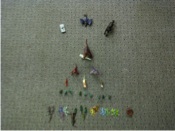
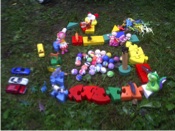
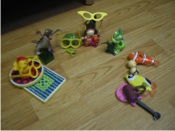
The following are basic instructions for how to facilitate the Diagram Debrief.
Step 1: Start with a blank canvas.
Clear a space for the group to assemble their masterpiece.
Step 2: Ask the group to make a picture for you.
Ask the group to make a picture for you of the team or group that they belong to. Who is a part of your team and how are they all connected?
Note: Depending on the dynamics of the group and their reason for coming together there are lots of ways to frame the Diagram Debrief. This conversation tool is great for any group whether it is made up of people who have been working together for years, or of people who just met five minutes ago. For some additional framing options please order a copy of the Diagram Debrief book.
Step 3: Identify where you will be standing to view the final product.
For some diagrams it won’t matter where you stand, but for some, your original vantage point will be very important. If the group creates a structure that has a top and a bottom it can add great depth to the conversation if you know which end is which and how they wanted you to first see their creation.
Step 4: Give the group their tools!
Toys make excellent tools because play is powerful! Do not underestimate it! Human beings are metaphorical and communicate through pictures and imagery without meaning to, and toys provide a wonderful medium for that communication. Additional instructions for creating a balanced Diagram Debrief toolkit are available in the book.
Step 5: Give the group some space.
Let the group know how much time they have to create and don’t stand over top of the group while they do it.
Step 6: Come back and stand at your designated spot. Listen to the group explain their creation.
Let the adventure begin!
Find more information in the book and expand your facilitation skills!
Buy your copy of the Diagram Debrief to find:
- Extensive directions for exploring completed diagrams
- Examples of completed diagrams and the elements you are looking for to gain greater insight
- Several pages of questions that will help you to start powerful conversations with your groups
- Instructions for how to create and cultivate your own Diagram Debrief Kit that opens up incredible doors of opportunity for communication and expression
- Additional ways to present the tool to the group in order to open up different kinds of conversation
- An introductory discussion of symbols and their meanings
- Case studies that demonstrate just how much breakthrough is possible with this tool
- A discussion on diagram structures and what participants communicate about power and influence through the overall shape of their diagram
Order The Diagram Debrief and a Diagram Debrief Kit today!
